
This guide may contain affiliate links. If you buy through them, we may earn a small commission at no extra cost to you. Learn more.
If your garage floor is where things go when you don’t know where else to put them, you don’t need a remodel. You need to get things up off the floor and onto the walls, and you can usually do that for well under $300. This guide is for homeowners and renters with a one- or two-car garage who want a cleaner, more usable space without guessing at what to buy.
Disclosure: We may earn a commission when you purchase through links on this page, at no additional cost to you.
The quick answer
- Measure before you buy. Most garage storage returns come from shelves that are too deep or too tall for the space.
- Start with one freestanding shelving unit. It usually clears the most floor space per dollar.
- Use walls for things with handles. Rakes, brooms, cords and bikes belong on a rail or pegboard, not leaning in a corner.
- Go overhead last. Ceiling racks are great for seasonal bins, but only after you know what’s left.
- Budget split that works for most garages: about half on shelving, a quarter on wall storage, a quarter on bins and hooks.
Before you buy: measure these four things
Grab a tape measure and a notepad (or the free checklist below). Five minutes here saves a return trip.
- Wall length and clear height. Measure every wall you could use, then measure up to the lowest obstruction: garage door track, opener, light fixture, outlet or window. That number, not the ceiling height, is your real maximum.
- Depth you can give up. Park your car where it normally goes and measure from the bumper (and both doors, fully opened) to the wall. Shelving deeper than that gap will cost you a door ding.
- What you’re actually storing. Do a quick sort into four groups: long-handled tools, bins and boxes, bulky items (coolers, bikes, ladders) and small stuff (screws, tape, chargers). Each group wants a different kind of storage.
- Wall type. Knock on the wall and find the studs. Drywall over studs, bare studs, block and concrete each need different anchors. Wall-mounted storage is only as strong as what it’s screwed into.
Free printable: Garage Measure-First Checklist
A one-page printable with spaces for every measurement above.
How we chose these ideas
Each idea below was judged on the same five things:
- Floor space recovered per dollar. How much stuff it gets off the floor for the money.
- Fit for a typical garage. Works with standard parking depth and a garage door in the way.
- Install difficulty. Can a first-time homeowner do it in an afternoon with basic tools?
- Flexibility. Can it be moved, extended or reconfigured later?
- Honest drawbacks. Every idea gets a “watch out for.” If we couldn’t find one, we didn’t look hard enough.
See our Editorial Policy for how we research and update recommendations.
7 garage storage ideas under $300
1. Freestanding steel shelving unit
Our pick: Husky 5-Tier Heavy Duty Boltless Steel Shelving Unit (48 in W x 78 in H x 24 in D) · Home Depot
- Best for: Bins, paint cans, boxes and anything heavy that doesn’t fit on a wall.
- Why it made the list: It’s the fastest way to clear a big chunk of floor. No wall anchoring is needed for the unit to stand, it moves with you, and adjustable shelf heights let you fit tall bins on the bottom and small items up top.
- Watch out for: The listed weight capacity is usually per shelf on an evenly spread load, not one heavy item in the middle. This unit is 24 inches deep, so compare that to your parking gap from the measuring step. Check the manufacturer’s rating and anchor tall units to the wall with an anti-tip strap, especially if kids are around.
- Typical price range: $80–$300 depending on size and capacity. Check current price
2. Wall-mounted rail system
Our pick: Rubbermaid FastTrack Garage 8-Piece Storage Rail System · Lowe’s
- Best for: Rakes, shovels, brooms, extension cords, ladders and folding chairs.
- Why it made the list: One rail screwed into studs gives you a row of movable hooks, so you can rearrange as your gear changes. It uses wall space that’s usually wasted above the car’s hood line.
- Watch out for: Hooks are often sold separately, and the kit price can climb once you add enough of them. Price the rail and the hooks together before deciding.
- Typical price range: Check current price. Starter kits and add-on hooks vary widely.
3. Pegboard or slatwall panel over a workbench
Our pick: Wall Control Metal Pegboard Utility Tool Storage Kit · Wall Control
- Best for: Hand tools and small items you grab often.
- Why it made the list: Seeing every tool at a glance means you stop buying duplicates. Metal pegboard tends to hold hooks better than hardboard over time.
- Watch out for: Cheap hooks fall out when you pull a tool off. Look for locking hooks or hook sets designed for that panel.
- Typical price range: Check current price.
4. Overhead ceiling storage rack
Our pick: NewAge Products VersaRac Pro 4 ft x 8 ft Height-Adjustable Overhead Rack · Home Depot
- Best for: Seasonal bins, holiday decorations and camping gear you touch a few times a year.
- Why it made the list: It uses space nothing else can reach, above the car and below the ceiling.
- Watch out for: This is the one to be careful with. It must be mounted into ceiling joists following the manufacturer’s instructions, and it can conflict with the garage door’s travel and the opener. Measure the door’s open position before buying. If you’re unsure about your ceiling framing, skip this one or get help.
- Typical price range: Check current price.
5. Bike hooks or a vertical bike rack
Our pick: Steadyrack Classic Rack · Steadyrack
- Best for: Households with one to four bikes taking up floor space.
- Why it made the list: Bikes are awkward floor hogs. Hanging them vertically along a wall can free up a surprising amount of room for very little money.
- Watch out for: Hanging by the wheel isn’t for everyone. Some people prefer horizontal wall mounts for heavier bikes. Check the rack’s listed weight limit against your heaviest bike.
- Typical price range: Check current price.
6. Clear, stackable storage bins with labels
Our pick: IRIS USA 72 Qt Stackable Clear Storage Bins with Lids (6-pack) · Target
- Best for: Small stuff that otherwise ends up in a junk pile: sports gear, car supplies, garden extras.
- Why it made the list: Bins are what make shelving actually work. Clear sides and labels mean you find things without unstacking everything.
- Watch out for: Measure your shelf depth and spacing before buying bins. A bin that’s slightly too tall wastes a whole shelf.
- Typical price range: Check current price.
7. Magnetic tool strip and small-parts organizer
Our pick: Husky Magnetic Tool Holder + Akro-Mils 26-Drawer Parts Cabinet · Home Depot (cabinet: https://www.walmart.com/ip/1136392364, Walmart)
- Best for: Screwdrivers, pliers, bits, screws and nails.
- Why it made the list: A small, cheap add-on that solves the “where’s the Phillips head” problem and keeps tiny parts out of coffee cans.
- Watch out for: Magnetic strips only hold steel tools, and a strong strip near a workbench will collect metal shavings. Mount it where that won’t matter.
- Typical price range: Check current price.
Putting it together: a weekend plan
- Friday night: empty and sort. Pull everything out onto the driveway in the four groups from the measuring step. Toss or donate anything you haven’t used in two years.
- Saturday morning: walls first. Mount the rail system and pegboard into studs. Hang long-handled tools and bikes.
- Saturday afternoon: shelving. Assemble the shelving unit, anchor it, and load heavy items on the bottom shelf.
- Sunday: bins and labels. Fill bins by category, label the short side that faces out, and put the least-used bins up high.
- Later, if needed: overhead rack. Once everything else is placed, decide whether you still need overhead space.
A sample $300 budget
| Priority | What to buy | Share of budget |
|---|---|---|
| 1 | One freestanding shelving unit | About half |
| 2 | Wall rail with hooks, or pegboard | About a quarter |
| 3 | Bins, labels, bike hooks, magnetic strip | About a quarter |
| Later | Overhead ceiling rack | Only if space is still short |
Prices change often, so check current prices before you shop and adjust the split to fit what your garage needs most.
FAQ
What should I buy first for garage organization?
Usually one freestanding shelving unit. It moves the most stuff off the floor and doesn’t depend on your wall type.
How deep should garage shelves be?
Measure the gap between your parked car’s bumper and the wall, and leave room to walk. Pick shelving shallower than that gap.
Can I install garage wall storage on drywall?
Mount into studs whenever you can. Drywall alone isn’t meant to hold heavy loads. Follow the manufacturer’s mounting instructions for your wall type.
Are overhead garage racks safe?
They can be when installed into ceiling joists exactly as the manufacturer specifies and kept clear of the garage door and opener. If you’re unsure about your ceiling framing, ask a pro.
How do I keep a garage organized after cleaning it out?
Give every category a fixed home, label bins, and do a 15-minute reset once a month.
Next step
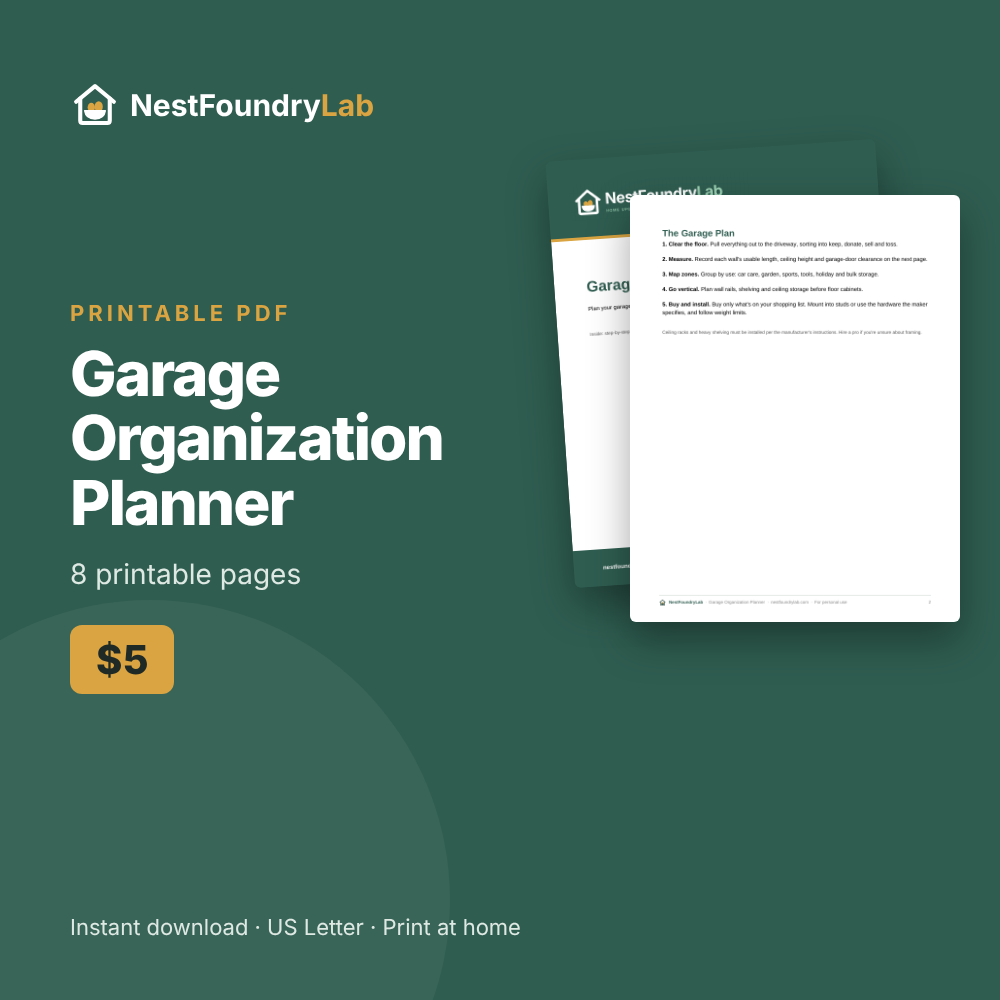
Want the whole plan on paper? The Garage Organization Planner has a wall measurement sheet, a zone map, a declutter tracker and a storage shopping list, so you buy once and buy right.
Instant PDF download. Or get all 10 planners for $29.
Related: Best Garage Tools for First-Time Homeowners · New Homeowner Essentials Checklist
Save this guide for later on Pinterest