This guide may contain affiliate links. If you buy through them, we may earn a small commission at no extra cost to you. Learn more.
Getting the keys is exciting. Then you walk in and realize there’s a lot nobody told you about: where’s the water shutoff? When were these smoke alarms installed? Do I own a ladder? This checklist covers what to check, set up and buy during your first month, in a sensible order. Safety comes first, then maintenance, then the fun stuff.
Disclosure: We may earn a commission when you purchase through links on this page, at no additional cost to you.
The quick answer
- Day 1: Change or rekey the locks, find the water shutoff and electrical panel, test smoke and CO alarms.
- Week 1: Note HVAC filter sizes, check the fire extinguisher, label the breaker panel.
- Week 2–3: Buy a basic tool kit and cleaning supplies, set up a maintenance schedule.
- Week 4: Start organizing and planning upgrades.
- Save décor and gadgets for after the basics.
Your first-day checklist
- Change or rekey exterior locks. You don’t know how many keys are out there.
- Find the main water shutoff. Learn how to turn it off in case of a leak.
- Find the electrical panel. Check whether breakers are labeled.
- Find the gas shutoff (if you have gas), and learn your utility’s guidance for gas leaks.
- Test smoke and CO alarms. Check their manufacture dates; alarms have a limited service life listed by the manufacturer.
Free printable: First-Week Safety Checklist
One printable page you can take with you.
How we prioritized this list
- Safety and security first.
- Prevents expensive problems (leaks, missed maintenance).
- Used in the first few months.
- Reasonable cost.
- Honest drawbacks for each purchase.
See our Editorial Policy.
Essentials to buy
1. Smoke and CO alarms (if needed)
Our pick: First Alert SCO5CN Battery-Operated Combination Smoke and CO Alarm · First Alert (also Lowe’s)
- Best for: Homes with old, missing, or past-date alarms.
- Why it made the list: Working alarms are one of the most important basics. Check local requirements for where they’re needed.
- Watch out for: Check the manufacture date on existing alarms and replace them according to the manufacturer’s guidance. Interconnected alarms can be hardwired; that may need an electrician.
- Typical price range: Check current price.
2. Fire extinguisher
Our pick: First Alert HOME1 Rechargeable Home Fire Extinguisher, UL rated 1-A:10-B:C · First Alert (also Target)
- Best for: Kitchen and garage.
- Why it made the list: Every home should have one where you can reach it quickly.
- Watch out for: Check the rating on the label matches the kinds of fires it’s meant for, and read the instructions before you need them. Check the gauge monthly.
- Typical price range: Check current price.
3. Water leak sensors
Our pick: Geeni Wi-Fi Water Leak Sensor (no hub required) · Home Depot
- Best for: Under sinks, behind the washer, by the water heater.
- Why it made the list: Inexpensive early warning for leaks you might not otherwise notice.
- Watch out for: Some need a hub for phone alerts. See our Smart Home Upgrades Under $100.
- Typical price range: Check current price.
4. Starter tool kit
Our pick: CRAFTSMAN 102-Piece Mixed Mechanics Tool Set (CMMT99449) · Lowe’s
- Best for: Move-in tasks: furniture, curtains, shelves, small repairs.
- Why it made the list: You’ll need tools in the first week. See our full tool guide for first-time homeowners.
- Watch out for: Big pre-made sets often include tools you won’t use.
- Typical price range: Check current price.
5. Step ladder
Our pick: Louisville Ladder 3 ft Aluminum Step Ladder, 225 lb, Type II (AS4003) · Home Depot
- Best for: Changing bulbs, smoke alarms, reaching high shelves.
- Why it made the list: You’ll use it constantly, and standing on chairs is how people get hurt.
- Watch out for: Check the ladder’s duty rating and height against your ceilings, and follow the safety labels on the ladder.
- Typical price range: Check current price.
6. HVAC filters (in the right size)
Our pick: Filtrete 1000 MPR Air Filters (in your size) · Filtrete
- Best for: Every home with forced-air heating or cooling.
- Why it made the list: Changing filters on schedule is one of the simplest maintenance tasks.
- Watch out for: Write down the exact size printed on your current filter. Follow your system and filter manufacturer’s replacement schedule.
- Typical price range: Check current price.
7. Plunger and drain snake
Our pick: Korky Beehive Max Toilet Plunger · Korky (also Lowe’s, Ace)
- Best for: Every bathroom.
- Why it made the list: You want these before you need them.
- Watch out for: Our pick is a toilet plunger. Get a flat cup plunger for sinks and tubs, and a plastic drain-cleaning strip for hair clogs.
- Typical price range: Check current price.
8. Surge protectors
Our pick: APC SurgeArrest Performance 11-Outlet Surge Protector (P11VT3) · Best Buy (also Lowe’s)
- Best for: TV, computer and other electronics.
- Why it made the list: Basic protection for your most expensive electronics.
- Watch out for: Not every power strip is a surge protector. Check the packaging and the joule rating.
- Typical price range: Check current price.
The first 30 days
Week 1: safety and security
– Change or rekey locks
– Test alarms, check manufacture dates
– Find the shutoffs and breaker panel
– Place a fire extinguisher in the kitchen
Week 2: learn your systems
– Write down HVAC filter size, water heater age, appliance models
– Label the breaker panel if it isn’t already
– Find your home’s warranty and manual paperwork
Week 3: maintenance setup
– Buy tools, cleaning supplies, and filters
– Set up a maintenance schedule (monthly, seasonal, yearly)
– Add leak sensors in risky spots
Week 4: organize and plan
– Set up garage, pantry and closet storage
– Make a list of upgrades by room and priority
– Set a budget for your first few projects
FAQ
What should a new homeowner do first?
Secure the home (locks), find the shutoffs, and test smoke and CO alarms.
What should I buy first for a new house?
Safety basics, a starter tool kit, a step ladder, filters, and cleaning supplies, before décor.
How much should I budget for home maintenance?
A commonly cited rule of thumb is about 1% of the home’s value per year, but it varies a lot with the home’s age and condition.
How do I keep track of home maintenance?
Use a calendar or a planner with monthly, seasonal and yearly tasks.
Next step
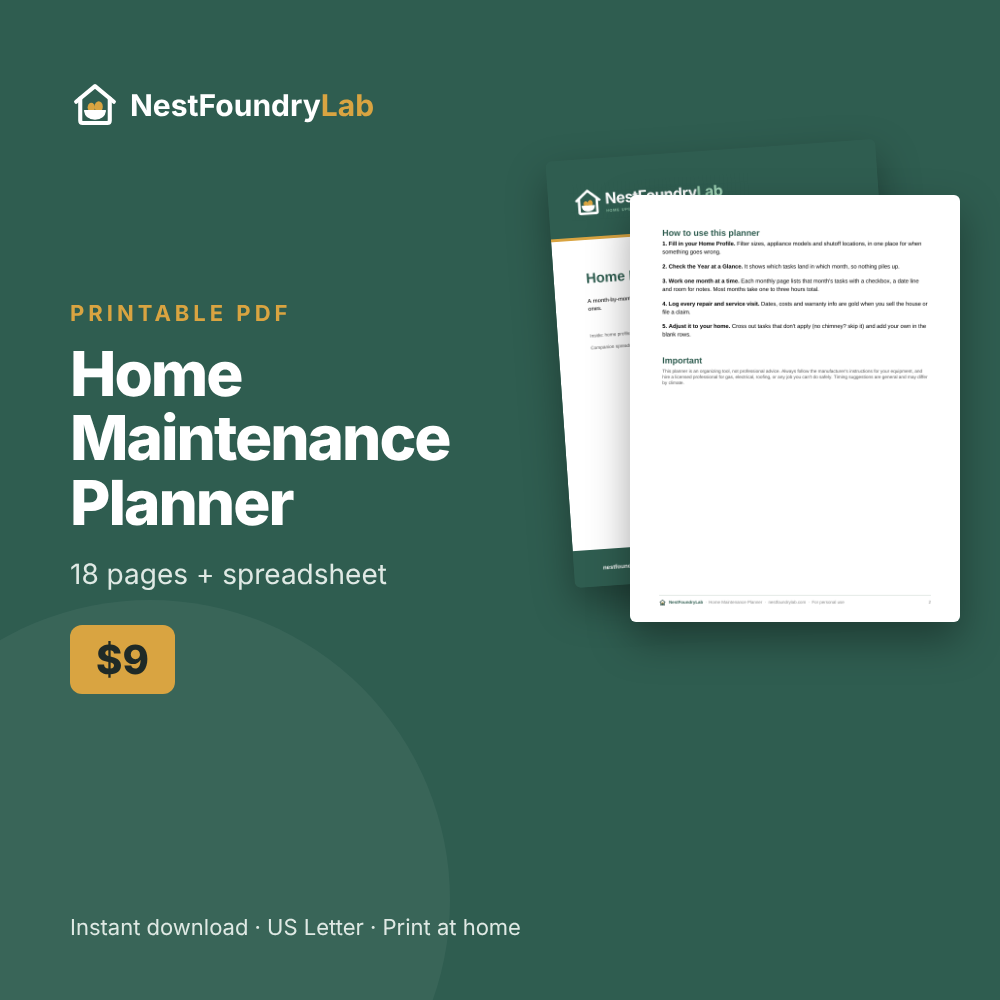
Make sure nothing gets missed. The Home Maintenance Planner ($9) includes a home profile, a year-at-a-glance schedule, 12 monthly checklists and a service log, plus a spreadsheet that tracks when each task is next due.
Instant PDF download. Or get all 10 planners for $29.
Related: Garage Tools for First-Time Homeowners · 10 Smart Home Upgrades Under $100
Save this guide for later on Pinterest